In conversation with Darren Way: From gang intervention to pioneering research unit - The Churchill Fellowship

In conversation with Darren Way: From gang intervention to pioneering research unit

What would you do with £10, two chairs, and an empty shopfront? For one Churchill Fellow the answer was obvious – set up a cutting-edge charity drawing on Fellowship learning, focusing on intensive long-term intervention for young people who are involved in or affected by serious harm.

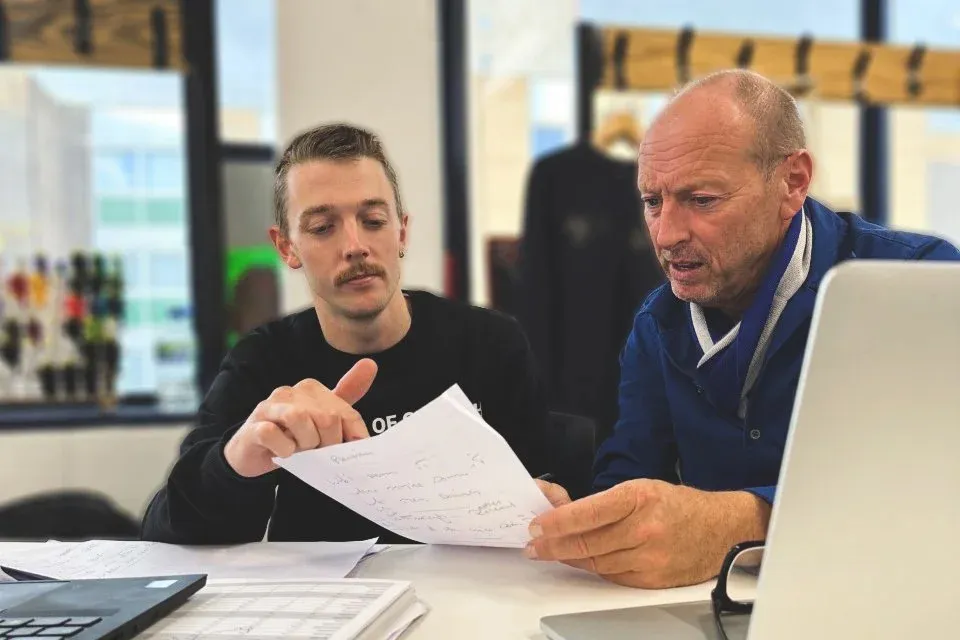
Darren (right) with a colleague designing the research unit. Download 'Darren Way and one of his colleagues at CARE'

From gang intervention to pioneering research unit

What would you do with £10, two chairs and an empty shopfront? For one Churchill Fellow the answer was obvious – set up a cutting-edge charity drawing on Fellowship learning, focusing on intensive long-term intervention for young people who are involved in or affected by serious harm.

Almost 25 years on, and Darren Way’s charity Streets of Growth has supported 6,000 young people, with each successfully completing a two-year intervention programme and going on to lead healthy productive lives.

Building on this success, Darren is launching an academic arm to shape national policy and practitioner training - a milestone made more significant by the ‘sliding doors’ moments that nearly led him down a different path.

"One night, I took it on myself, as a neighbour, to start doing intervention work to try and reengage those becoming lost to the streets."

Inspiration for a Churchill Fellowship

Brought up on a socially deprived council estate in Tower Hamlets, East London, Darren left school aged 16 with no real qualifications and began his working life as an apprentice painter and decorator.

Darren’s early work decorating a local community centre left a lasting impression; years later, he was recruited to help launch a creative arts youth centre - a defining moment in his journey.

"Through ambitious leadership, we ran innovative projects that kept many young people in education and away from anti-social behaviour. However, many others remained out of reach, falling into gangs and harmful activity. One night, I took it on myself, as a neighbour, to start doing intervention work to try and reengage those becoming lost to the streets.”

However, Darren’s success in protecting young people put him at personal risk from the criminal elements seeking to exploit them.

On the brink of burnout, a pivotal meeting with Carnegie Foundation researchers visiting the youth centre from the United States led to Darren being flown to America’s east coast, where he toured pioneering projects in Boston, New York, and Pittsburgh, gaining critical insights into youth intervention and enterprise.

“I saw that what I had been trying to do as a neighbour, and the challenges I was facing, these people were doing and overcoming on a formal basis, through community-led organisations. I was intrigued to see if this could be translated, replicated, and advanced in the UK.”

Fast forward to 2000, and Darren was awarded a Churchill Fellowship to travel to America. Extending his stay with his own funding, he spent three months in Boston, Vermont, North Philadelphia, Washington, and New York, immersing himself in interventionist youth work, which he found was way ahead of anything he had experienced happening in the UK.

"My advice to future Churchill Fellows is to not expect your findings to be instantly embraced. Real change often takes time."

Putting learning into practice

Back in London, and inauspiciously on the day the Twin Towers were attacked, Darren opened Streets of Growth.

“We had a desolate shop in Bow, East London, for premises, and I had £10 in my pocket and two chairs that were left in the shop when we took it over. But what I also had was a vision and stood next to me were my fellow co-founders Diane Peters (CEO) and Lucky Nessa (Programme Director) – who was one of the young people I’d coached and worked with back in the Nineties.”

From small acorns, mighty oaks grow. Through their two-year Appropriate Intervention Plus Model®, Streets of Growth works with young people aged 15 to 21 experiencing and caught up in criminal harm outside the home, to live out of harm’s way and lead healthy thriving lifestyles.

After years of moving between short-term leases, the charity secured stability in 2023 through a partnership with Unite Students. Their new long-term headquarters now serves as the central hub for all frontline youth intervention and employment programming.

In late 2025, BSQ Group provided Darren with Covent Garden office space to launch the Centre for Applied Research & Evaluation (C.A.R.E.). This hub aims to secure academic recognition for his Churchill Fellowship research and subsequent practice, supported by a specialised team.

“Our goal is to both inform and rewrite policy in this country for our area of work. I have spent three decades of my life tackling the age-old issue of adolescent street gangs. It’s now time to start working with a different kind of group: those shaping decisions and policy.”

Legacy of a Churchill Fellowship

Darren’s work has won him plaudits. He achieved the Churchill Fellowship’s Viscount De L'Isle Award in 2001. More recently, he was selected by an independent panel to receive a British Citizen Award (BCAc) for outstanding services to the community. But he is most proud, by far, of the achievements and awards his staff and the very young people have made to literally save and change the lives of themselves, of others, and of their neighbourhoods.

“My Fellowship gave me a once in a lifetime opportunity to take me and my neighbourhood practice international, and in return bring international best practice back to my neighbourhood and beyond.

“It is striking that since my Fellowship in 2000, it has taken over 20 years for my Fellowship, charity, and approach to become what looks like an ‘overnight success’. My advice to future Churchill Fellows is to not expect your findings to be instantly understood or embraced. Real change often takes time and requires building a solid demonstrative model to prove your theory before the world is ready to catch on or catch up.”

Disclaimer

The views and opinions expressed by any Fellow are those of the Fellow and not of the Churchill Fellowship or its partners, which have no responsibility or liability for any part of them.

Related

Blogs & conversations

Later living that makes the most of every moment

Amid growing pressures across housing, health, and care, Churchill Fellows Graham Russell and Oona Goldsworthy argue that the lessons from their Fellowships – integrated commissioning, mixed communities, and stronger collaboration – are needed more urgently than ever. They highlight how Brunelcare, the care charity they both work at, is beginning to apply these approaches, from reablement and redevelopment to community-focused work that aims to improve later living.

By Graham Russell ~ Oona Goldsworthy,

Blogs & conversations

Renegade Guides: the places we go, the stories we share

Writer, guide, and founder of Living London, Saira Niazi spent her Churchill Fellowship in the USA exploring how tours and storytelling can be more inclusive, ethical, and community-focused. Her travels took her through 41 neighbourhoods, 32 guided tours, and 36 interviews with “renegade guides,” organisers, and storytellers, culminating in the creation of the Renegade Guides Handbook. Since its launch, Saira has been sharing her findings widely and continues to lead tours, write, and collaborate with communities.

By Saira Niazi,

Blogs & conversations

How rural Canada is rethinking migration

Keith Ruffles travelled across Canada to explore how rural communities are using migration to reverse population decline. Over five weeks, he visited six towns taking part in the Rural and Northern Immigration Pilot (RNIP), meeting with local coordinators, federal agencies, and migrants like Natalia and Mohammad, who shared their experiences of settling in Canada. In this blog, Keith reflects on what the UK could learn from Canada’s community-driven approach to migration, and how the Fellowship gave him the time, space, and connection to explore these issues in depth.

By Keith Ruffles,

Blogs & conversations

Bringing Rural Abuse into Focus: What survivors are telling us, and why we must listen

As part of my Fellowship, I travelled across rural regions in the USA, Canada, and Australia, connecting with experts and victim-survivors to explore how to improve safety and achieve equity. My learning and earlier conversations with Rhianon Bragg – a survivor whose story reveals deep cracks in our justice system – helped shape my focus post-Fellowship, laying the groundwork for a new social enterprise to raise the status of rural domestic abuse in public policy and support more coordinated, realistic responses.

By Judith Vickress,

Newsletter Sign Up